Showing the single result
YANCHENG YONGKANG ENVIRONMENTAL PROTECTION EQUIPMENT CO.,LTD

-
Email
sales@ppmfilter.com -
Phone(whatsapp/wechat)
008615861970633 -
CONTACT PERSON
Anna Zhu
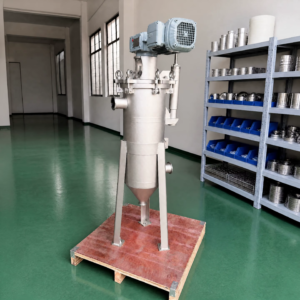
An automatic self-cleaning filter removes suspended solids from a liquid stream continuously, without stopping the process to change a filter element. Instead of disposable filter bags or cartridges, the media is a permanent stainless steel wedge-wire screen. When the screen loads up, a scraper travels across its surface and pushes the collected cake into a purge chamber, where a short discharge carries it to drain. Flow continues throughout the cleaning cycle.
This makes the category a different purchase decision from bag or cartridge filtration. You are not buying consumables — you are buying a unit that has to survive thousands of cleaning cycles in your specific medium.
How it works. Liquid enters the housing and passes inward through the wedge-wire screen; particles larger than the slot opening stay on the outside surface. As the cake builds, differential pressure rises. At a preset threshold — typically 0.05 to 0.1 MPa — the scraper assembly rotates or travels along the screen and shears the cake off. A purge valve opens briefly and discharges the concentrate. The screen is back to its clean pressure drop and the cycle repeats automatically, driven by a timer, a differential pressure switch, or both.
When to specify a self-cleaning filter instead of bag or cartridge.
Solid loading is high and bags would need changing more than once a week.
The medium is viscous — syrup, honey, ink, paint, resin, molasses — where a disposable bag blinds off quickly.
The line runs continuously and a changeout stop is not acceptable.
Filtration rating in the 50–2,000 μm range is sufficient; finer polishing still needs a cartridge downstream.
Disposal cost or product loss from spent filter media is a concern.
When a bag or cartridge housing is the better choice. For clean, low-solid liquids, for ratings below 50 μm, or where the process runs in batches and can be stopped, a bag or cartridge housing costs less to buy and is simpler to maintain. Many plants use both: a self-cleaning unit as coarse pre-filtration ahead of a polishing cartridge.
What to specify. Five numbers decide the unit: flow rate (m³/h), working pressure (bar), operating temperature (°C), filtration rating (μm), and solid loading (ppm or % by volume). Viscosity above roughly 100 cP changes the drive sizing and usually points to a scraper design rather than a backwash design. Body material follows the medium: SS304 for neutral liquids, SS316L where chloride is present, SS2205 for high-chloride or high-temperature duty.
Typical applications. Chemical and petrochemical intermediates, ink, coating and dye production, syrup and edible oil, tea and beverage pre-filtration, paint and resin, metalworking coolant, process water and wastewater reuse.
Maintenance. The screen is a wear item, not a consumable — inspect it annually for slot erosion and clean it with a caustic or acid soak if scale forms. Scraper blades and shaft seals are the parts that wear; both are replaceable without removing the housing from the line.
Send us the flow rate, medium, temperature and target micron rating, and we will confirm the model, screen slot size and drive type for your duty.